
TOI-561 b: Why a Lava Planet Reflects 75% of Starlight
Webb observations suggest a scorching lava world may reflect 75% of starlight, but the proposed silicate clouds remain a model-based explanation.
Contents
- The discovery in one minute
- TOI-561 b facts: distance, size and orbit
- Why should such a hot planet still have an atmosphere?
- What exactly did the telescope observe for 37 hours?
- The surprising clue: the nightside cannot explain all the missing heat
- A 100-unit energy example: why 75% reflection does not mean 75% less heat
- Could sand and rock really make clouds?
- Clouds are not a force field: what “protective sunscreen” really means
- Did the 2026 study overturn the Webb findings announced in 2025?
- Could the magma ocean continuously rebuild the air?
- Venus, Io or something different? Three comparisons
- Evidence ladder: what is measured, inferred and unknown
- What the atmosphere might be made of
- The most important unanswered questions
- What readers should not conclude from the headlines
- Why this study matters beyond one distant lava planet
- Practical guide: how to read the actual NASA figure
- Conclusion: the real surprise is the atmosphere, not an alien paradise
- Primary research, official images and further reading
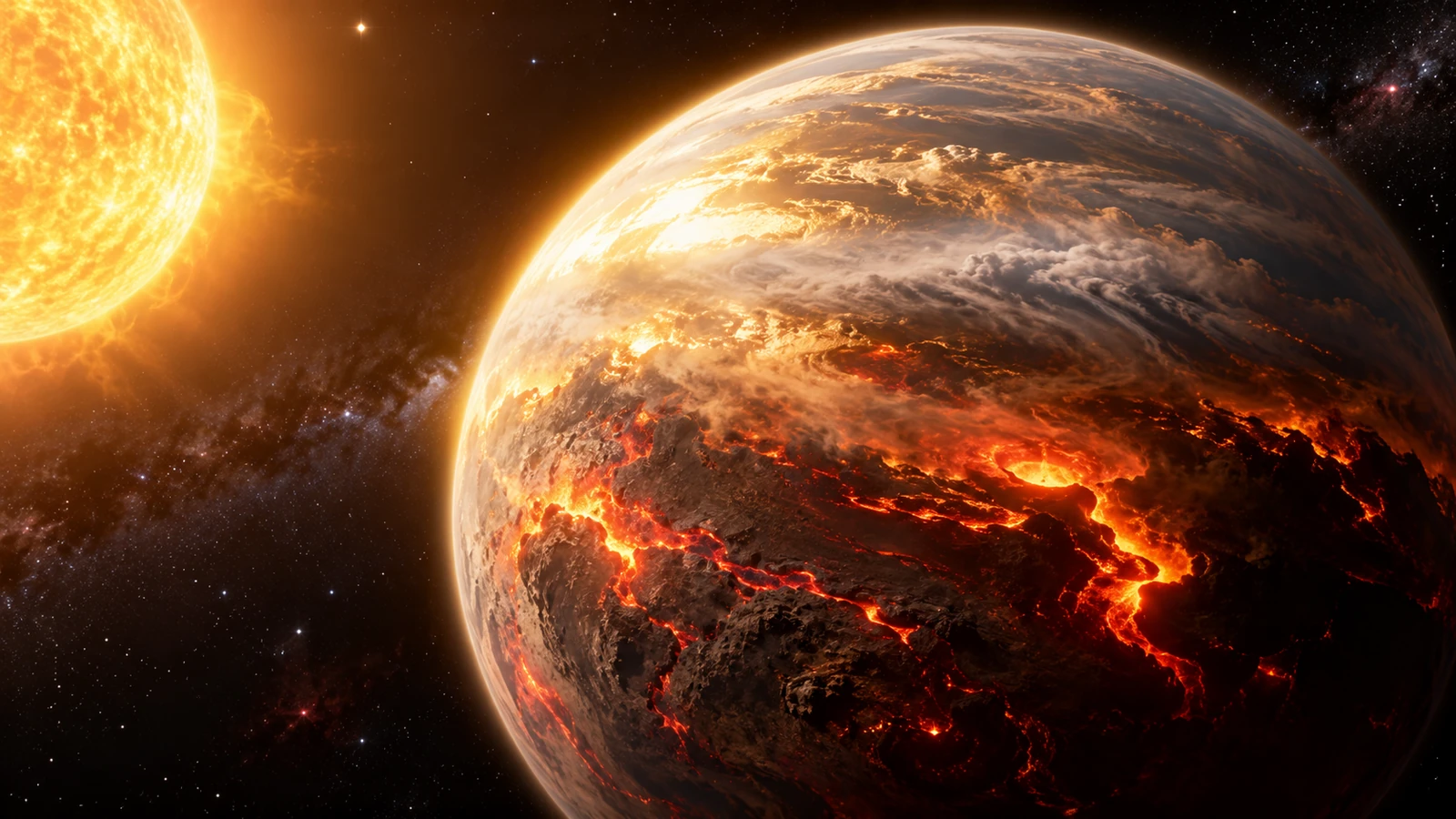
TOI-561 b may be one of the strangest rocky worlds studied by the James Webb Space Telescope. Although the lava planet races around its star in roughly 10.7 hours, a study publicised on 26–27 October 2026 finds evidence for a substantial atmosphere that appears to reflect roughly three-quarters of the incoming stellar energy. Mineral clouds are a leading explanation, not a photographically confirmed discovery. The planet remains extraordinarily hot and unsuitable for life as we know it.
The key result comes from a peer-reviewed paper in The Astronomical Journal, supported by the University of Waterloo report and the University of Birmingham announcement. It builds on NASA’s December 2025 discussion of an unexpectedly substantial gaseous envelope. This guide separates what Webb actually measured from what climate models suggest. Sources checked: 27 October 2026.
The discovery in one minute
Webb monitored changes in the system’s infrared brightness for 37 hours, following more than three revolutions of the planet. A technique called a spectroscopic phase curve uses those variations to constrain the distribution of heat. The nightside was not bright enough to explain all the apparently missing dayside energy through heat transport alone. A model with high reflectivity and moderate redistribution fits the findings better than a simple dark bare-rock model.
Climate simulations suggest that silicon dioxide (SiO2) and magnesium silicate (MgSiO3) could condense into high-altitude clouds, especially near the border between daylight and darkness. Those clouds could bounce stellar radiation away. The exact molecules in the atmosphere have not yet been measured securely; the possibility of silicon-rich clouds should not be written as a confirmed chemical inventory.
TOI-561 b facts: distance, size and orbit
TOI-561 b is a super-Earth in the constellation Sextans, around 280 light-years from our solar system. The designation “super-Earth” describes a size or mass class—not an Earth-like climate or the presence of life. NASA’s exoplanet catalogue lists a radius of about 1.397 Earth radii, a mass around 2.02 Earth masses, and an orbital distance close to 0.01064 astronomical units (AU). Different publications may round the orbital period to 10.6, 10.7 or nearly 11 hours.
At that small separation, the star dominates the planet’s energy budget. TOI-561 b is thought to be tidally locked, keeping roughly the same hemisphere toward the star. This is why scientists distinguish a permanent dayside and a permanent nightside. Its presumed molten surface is not an ocean of liquid water; the “ocean” here refers to extremely hot molten rock, or magma.
| Characteristic | Best-supported description |
|---|---|
| Distance | Approximately 280 light-years |
| Radius / mass | About 1.4 Earth radii / 2 Earth masses |
| Orbit | Approximately 10.7 hours; about 0.0106 AU |
| Rotation | Probably tidally locked |
| Atmosphere | Strong evidence from infrared emission and phase-curve models |
| Cloud composition | Silicate-cloud hypothesis; unconfirmed |
Why should such a hot planet still have an atmosphere?
Close-in rocky planets receive enormous stellar radiation. Over long periods, ultraviolet light and stellar particles can heat their upper atmospheres and help gases escape into space. For an ultra-short-period world, early theoretical expectations often favoured a bare rock or only a tenuous rock-vapour shroud. The new measurements make that simple picture less convincing for TOI-561 b.
This does not imply that scientists have overturned the physics of atmospheric escape. There may be several balancing processes: an exceptionally large original reservoir of volatile material; gases continuously released from molten rock; or cooling through reflection and atmospheric circulation. A long-lived atmosphere is an outcome needing explanation, not a statement that starlight has become harmless.
What exactly did the telescope observe for 37 hours?
Astronomers cannot resolve TOI-561 b into a detailed photograph; the planet is too far away and too close to its star on the sky. Instead, Webb’s NIRSpec instrument monitored infrared light in roughly the 3–5 micrometre range. As the planet travels around the star, the visible proportion of its hotter and cooler hemispheres changes, while its passage behind the star briefly removes the planet’s contribution to the combined light. A precise phase curve can therefore constrain the planet’s emitted heat.
The researchers also modelled small brightness fluctuations produced by the star itself—sometimes described as stellar granulation—along with possible offsets in the planet’s hottest region. Accounting for these effects matters because a tiny signal mistakenly attributed to a planet could otherwise distort its inferred nightside temperature. This is a measurement-and-modelling exercise, not a direct detection of a cloud droplet.
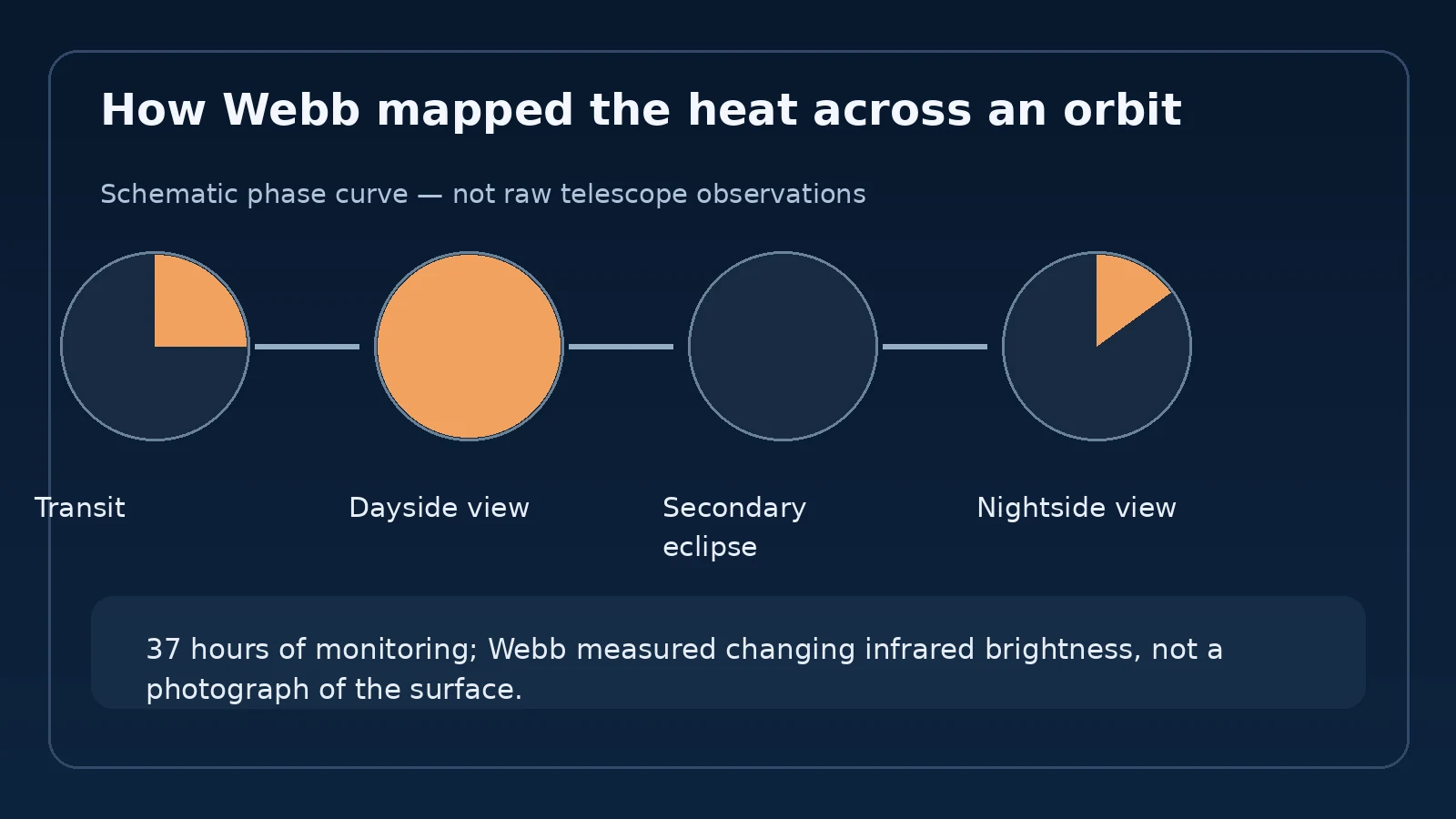
The diagram above is an original educational schematic. It is not a screenshot or a reproduction of Webb’s real phase-curve data. NASA provides a genuine earlier NIRSpec emission spectrum for readers who want to see actual measurements and model comparisons.
The surprising clue: the nightside cannot explain all the missing heat
The December 2025 Webb results suggested a dayside cooler than an exposed, dark, molten surface would be expected to appear in the relevant infrared wavelengths. One hypothesis was that winds were carrying enough energy to the nightside to reduce the dayside heat signature. This year’s longer analysis checked that idea against the phase curve. The nightside was not bright enough to carry away all the missing energy under a low-reflectivity scenario.
The team therefore favours a combination of moderate heat circulation and a high Bond albedo. That term describes the fraction of all incident stellar energy that a planet reflects, averaged over wavelengths and directions. It differs from apparent brightness in one photograph or how reflective a surface looks at one wavelength. News reports simplify the inferred reflectivity to about 75%.
A 100-unit energy example: why 75% reflection does not mean 75% less heat
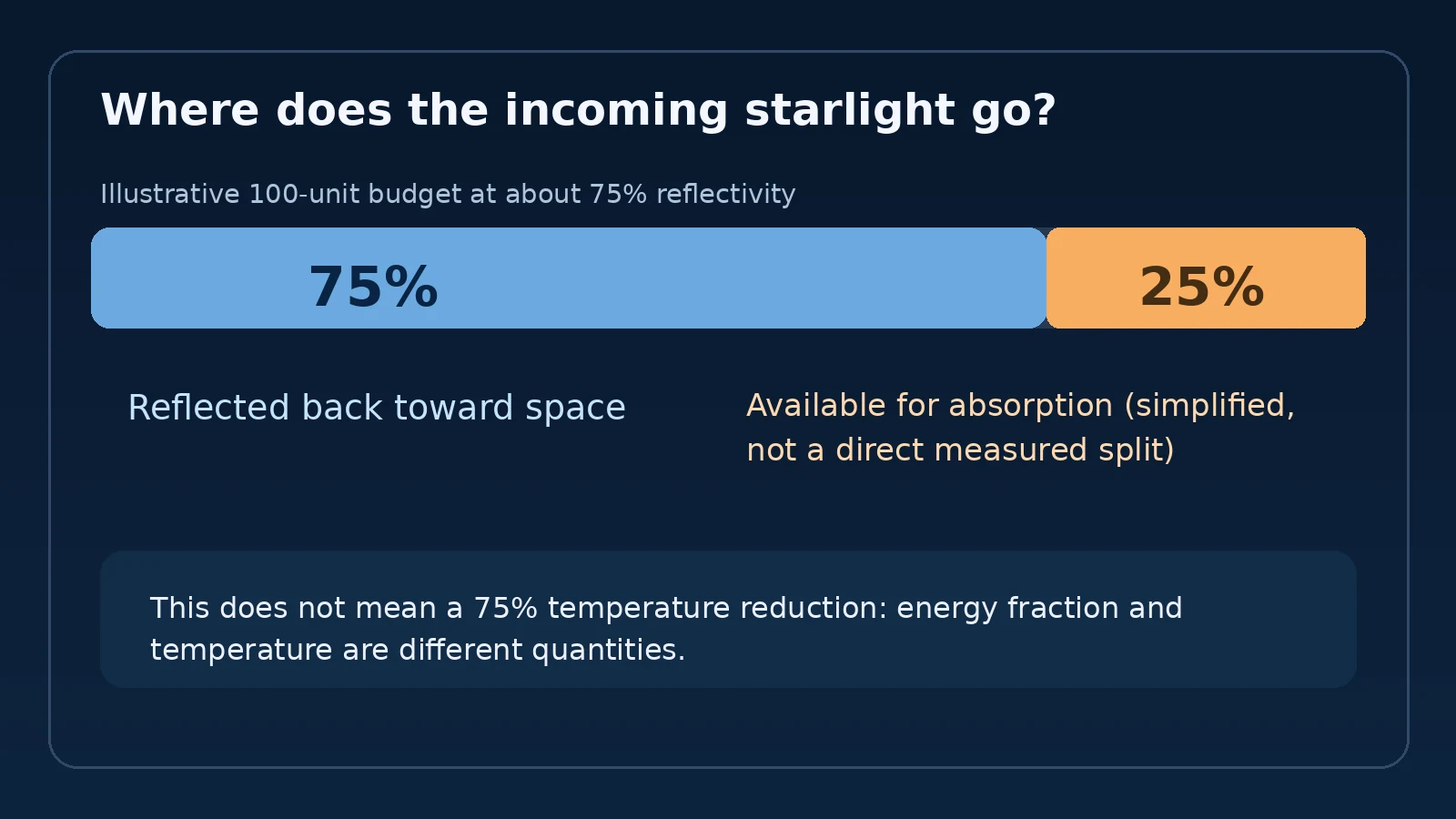
Imagine 100 identical units of stellar energy reaching the top of the atmosphere. In a simplified world that reflects 75%, around 75 units return toward space and 25 remain available for absorption. A dark comparison world reflecting only 10% would retain 90 units instead. Under those artificial assumptions, the highly reflective world absorbs 65 fewer units per 100. This is an illustration of an energy fraction—not a reconstructed observation and not a claim about the planet’s actual surface flux.
Temperature does not fall by 75% in degrees Celsius. Even a basic radiative-equilibrium temperature scales approximately with the fourth root of absorbed energy, and real atmospheres introduce greenhouse absorption, winds, emission at different altitudes, and possible interior heat. Treating a reflectivity percentage as a matching temperature percentage would be a serious scientific error.
| Illustrative model | Reflected | Available for absorption |
|---|---|---|
| High-reflectivity TOI-561 b-style case | 75 of 100 | 25 of 100 |
| Dark hypothetical world | 10 of 100 | 90 of 100 |
| Difference in retained units | — | 65 fewer in the first case |
Could sand and rock really make clouds?
On Earth, water droplets and ice crystals create most familiar clouds. At far higher temperatures, different substances can vaporise and later condense as the air cools. Silicon dioxide—the chemical family associated with quartz—and magnesium silicate are examples of minerals that can participate in such high-temperature chemistry. These are proposed atmospheric condensates, not beach sand floating as ordinary grains.
The climate simulations explored where such particles might form. A promising region is near the terminator: the boundary where the permanently lit and dark hemispheres meet. A cloud layer there could act as a bright screen. However, modelling that cloud layer successfully does not prove that the exact minerals or droplet sizes are present; future spectroscopy must test these possibilities.
Clouds are not a force field: what “protective sunscreen” really means
The term “sunscreen” in university announcements is a metaphor for reflection. Bright clouds may prevent some radiation from being absorbed, making conditions less energetic than on a completely dark, bare planet at the same orbit. They do not remove the stellar radiation source or transform TOI-561 b into a comfortable world. Its proximity to the star still drives conditions compatible with molten rock.
This distinction also guards against an easy headline error: “A habitable lava planet protected by clouds.” The study does not claim habitability. Evidence for an atmosphere is important to understanding rocky exoplanet evolution; it is not evidence of oceans of water, biology, breathable air, or Earth-like weather.
Did the 2026 study overturn the Webb findings announced in 2025?
No. The findings are complementary. In December 2025, NASA reported that the planet’s dayside infrared emission was inconsistent with the simplest bare-rock interpretation and more compatible with a substantial atmosphere. The 2026 study widened the analysis to phase-dependent brightness throughout the orbit, adding new constraints on the nightside and planetary energy budget. The second result strengthens and sharpens the first rather than replacing it.
A crucial subtlety: a model spectrum displayed by NASA in 2025 used an atmosphere consisting of 100% water vapour as a test case. This was not the chemical composition detected on TOI-561 b. Likewise, the 2026 silicate-cloud result identifies a plausible explanation within models, not a laboratory-grade inventory of clouds.
| Study stage | What was measured | Main advance | Still uncertain |
|---|---|---|---|
| 2025 reporting | Dayside infrared emission during eclipse-related observation | Bare-rock spectrum inadequate; substantial atmosphere favoured | Specific gas mixture and cloud layers |
| 2026 analysis | 37-hour spectroscopic phase curve including nightside constraints | High reflectivity plus moderate heat transport | Precise atmospheric chemistry and lifecycle |
Could the magma ocean continuously rebuild the air?
One proposed explanation is a vigorous exchange between molten interior and atmosphere. As liquid rock circulates, dissolved volatiles may be released as gases, while other compounds could be reabsorbed or react with the surface. If the replenishment rate offsets long-term losses, an atmosphere can persist even in an environment where escape is strong. This is a hypothesis about a dynamic supply-and-loss balance, not direct evidence that scientists have observed volcanic eruptions on the planet.
The idea has broader implications: some rocky exoplanets might retain secondary atmospheres through ongoing geological activity. Yet scientists still need information about the planet’s original volatile inventory, interior chemistry, stellar radiation history and escape processes before they can determine whether this mechanism truly operates on TOI-561 b.
Venus, Io or something different? Three comparisons
Venus is an instructive analogy because its thick cloudy atmosphere reflects a large share of incoming sunlight. Jupiter’s volcanic moon Io is a useful analogy for sulfur-bearing gases associated with intense volcanic activity. TOI-561 b might show physical processes reminiscent of both, but it is not proven to possess either Venus’s carbon-dioxide-dominated atmosphere or Io’s sulfur-dioxide environment. These are competing chemical possibilities that require testing.
Compared with Earth, the contrast is even sharper: Earth’s atmosphere, climate, oceans and life have developed under very different irradiation conditions. A similar bulk planetary size tells us almost nothing about whether an exoplanet is livable. That is why astronomical terms such as “super-Earth,” “atmosphere” and “clouds” need context before they appear together in a headline.
| World | Why compare it? | Key limitation |
|---|---|---|
| TOI-561 b | Candidate mineral clouds; molten-rock environment | Gas composition not directly established |
| Venus | High-reflectivity cloudy atmosphere | Distinct conditions and known CO2-rich chemistry |
| Io | Volcanic release and sulfur-bearing gas | Moon, not a super-Earth; different atmospheric environment |
| Earth | Reference for rocky planets | Not a useful analog for extreme irradiation |
Evidence ladder: what is measured, inferred and unknown
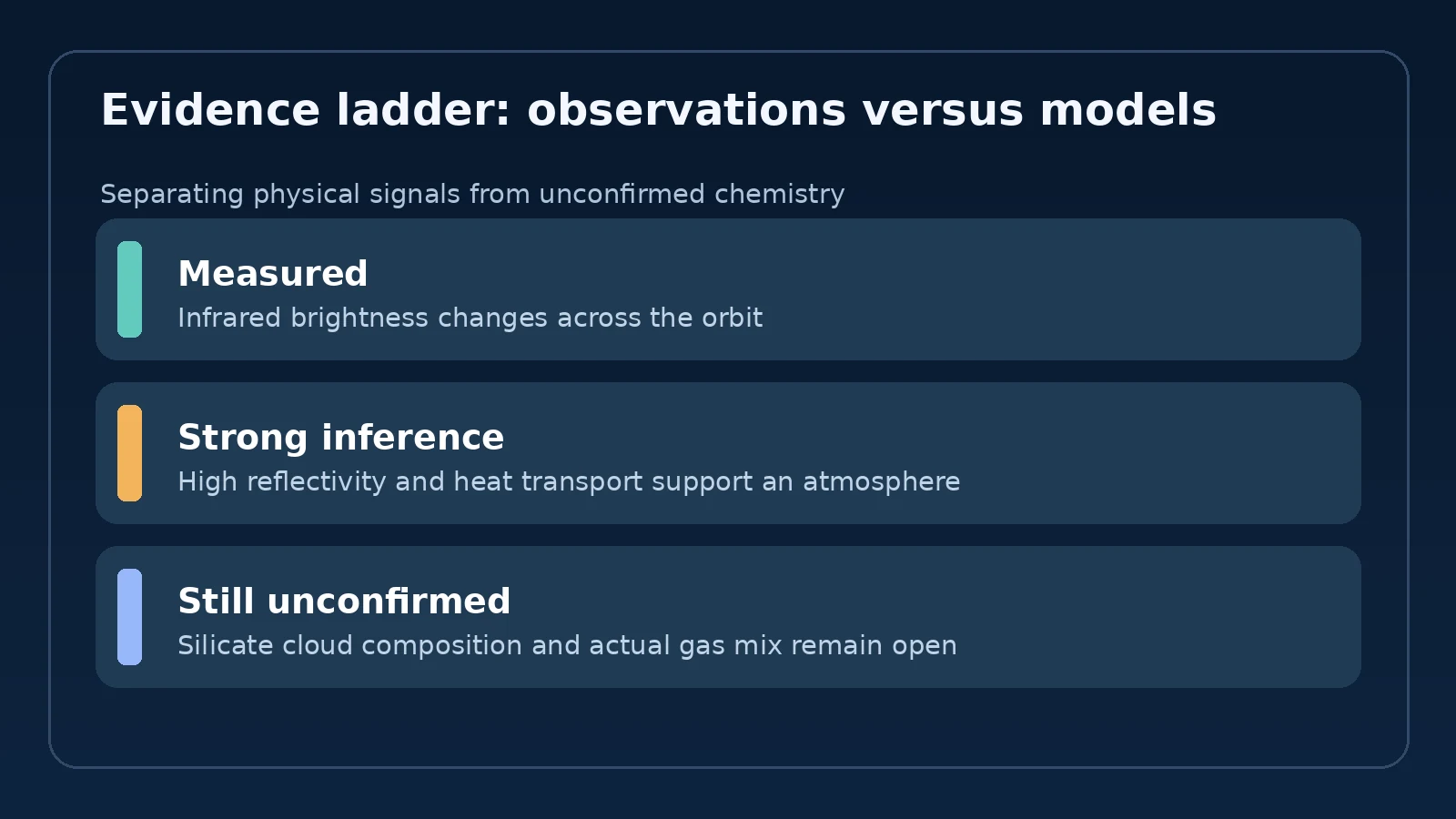
The most reliable way to read an exoplanet story is to rank the claims. Observed: infrared variations linked to planetary orbital phase, including eclipse-related brightness changes. Inferred through modelling: a high-reflectivity energy budget and atmospheric heat redistribution, which together strongly favour a substantial atmosphere. Not yet confirmed: exact cloud species, atmospheric pressure, the dominant gases, and how efficiently the molten interior replaces escaped molecules.
A second ranking matters: “supports” does not always mean “uniquely proves.” Several model combinations can sometimes fit overlapping parts of the data. Webb’s long baseline and treatment of stellar variability reduce ambiguity, but they do not eliminate every degeneracy in atmospheric composition. This is precisely why independent wavelength measurements are valuable.
What the atmosphere might be made of
The research team discusses scenarios in which carbon dioxide, sulfur dioxide and other volatile gases play roles. Silicate clouds could also contribute to reflectivity if atmospheric temperatures and circulation permit condensation. But neither the total pressure nor a definitive recipe for gas abundances has been established by this phase-curve study. In particular, a mention of water vapour in comparative models must not become a claim that liquid water exists on TOI-561 b.
Determining composition is not simply a matter of taking a visible-light snapshot. Different molecules absorb and emit radiation at particular wavelengths; clouds can obscure some spectral features, while changes in temperature can mimic some aspects of chemistry. Observations spanning a broader infrared range would help researchers separate these effects and investigate whether the atmosphere behaves more like a hotter Venus, a volcanically supplied Io-like environment, or a distinct category.
The most important unanswered questions
There are at least four unresolved issues. First, what produces the reflectivity—silicate clouds, another condensate, or a mixture of causes? Second, which gases dominate and how does their chemistry change with altitude? Third, how much energy crosses from dayside to nightside? Fourth, did the atmosphere survive from early times or is it being continually renewed? These questions are related, but a future single observation may not settle all of them.
Researchers particularly want longer-wavelength Webb measurements because they can constrain temperatures and search for chemical signatures under different observational conditions. Combining multiple instruments, phase curves and evolutionary models is likely to be more informative than treating one brightness estimate as an atmospheric chemical fingerprint.
What readers should not conclude from the headlines
It is inaccurate to say that Webb photographed rock clouds; the clouds are a model-based explanation. It is misleading to claim that 75% reflectivity equals a 75% drop in surface temperature. It is equally wrong to describe the planet as a potentially habitable “second Earth.” Finally, a comparison with Venus or Io does not establish the actual atmospheric chemistry of TOI-561 b. Making these distinctions does not weaken the discovery—it makes its implications clearer.
The strongest accurate headline is that a world expected to struggle to hold an atmosphere appears to have one, and astronomers have identified a plausible reason for its unexpectedly low dayside energy signature. That is already a major clue about how rocky planets interact with their stars and molten interiors.
Why this study matters beyond one distant lava planet
Many rocky exoplanets discovered so far are easier to detect because they orbit close to their stars. Understanding the atmospheric survival of such worlds helps researchers interpret the population as a whole: which planets become airless, which can rebuild an atmosphere, and how minerals, volatiles and interior chemistry shape what telescopes see. TOI-561 b is extreme, but extreme cases test the boundaries of planetary models.
Future research on more temperate small planets will still need separate evidence. A hot lava planet does not tell us that a cooler world has life. What it does reveal is that apparently simple assumptions—such as “small planet plus intense radiation equals no atmosphere”—can fail, especially when interior activity and cloud physics matter.
Practical guide: how to read the actual NASA figure
Open NASA’s original TOI-561 b NIRSpec emission-spectrum page. Start with the horizontal axis: it reports infrared wavelength in micrometres, not distance across the planet. Next identify the observed points and their uncertainty bars. Then compare the different hypothetical spectra: the bare-rock case and atmospheric models predict different brightness patterns. The figure illustrates why the team suspected an atmosphere; it is not a photograph of mineral clouds.
When reading a popular news story, look for three clear labels: observations, models and uncertainties. If a picture shows lava seas beneath bright clouds, check its caption: even attractive NASA or university artwork will usually be labelled an artist’s concept. The featured illustration and explanatory diagrams in this Horus Valley article are likewise educational artwork—not a photograph taken on the planet.
Conclusion: the real surprise is the atmosphere, not an alien paradise
Webb’s 37-hour phase-curve data adds a major clue to the mystery of TOI-561 b. The planet appears to reflect an unusually large share of incoming radiation while circulating some heat around its globe. Clouds made of silicates are physically plausible and may explain the high reflectivity, but the atmosphere’s detailed chemistry is an open problem. A rocky planet can be atmospheric and unimaginably hot at the same time.
The value of the discovery is the new way it tests atmospheric survival, cloud formation and the relationship between a planet’s surface and sky. The next decisive steps will require further wavelength coverage and careful comparisons with alternative models—not stronger claims than the current evidence can support.
Primary research, official images and further reading
This article was independently assembled and fact-checked on 27 October 2026. The current report concerns a 2026 phase-curve analysis, not a new photograph taken on the announcement date. The accessible preprint predates the universities’ October news releases. The links below separate the peer-reviewed research, original researchers’ commentary, NASA observational graphics, and published catalog parameters.
- Boucher et al., 2026, The Astronomical Journal — original peer-reviewed phase-curve study.
- Open-access research preprint — the physical model, stellar variability treatment and clouds.
- University of Waterloo, 26 October 2026 — comments by study lead Lisa Dang.
- University of Birmingham, 27 October 2026 — contemporary university release.
- NASA, 11 December 2025 — preceding atmospheric evidence.
- NASA’s real NIRSpec emission spectrum — actual observation-based graphic with explanation.
- NASA exoplanet catalogue — period, mass, radius and orbital distance.
You may also like
 Science & Space
2026 ED138: Rubin’s New Dwarf Planet Candidate Explained
Explore 2026 ED138, Rubin’s dwarf planet candidate: the discovery, uncertain size, orbital measurements and observations needed for confirmation.
 Science & Space
Could Mars Dust Harm Astronauts? What Perseverance Found on Spacesuit Materials
Perseverance detected ultrafine dust clinging to spacesuit-like materials. Explore sizes, health evidence, habitat protection and NASA’s preliminary limits.
 Science & Space
SpaceX Space Jellyfish Explained: Why Rockets Create Glowing Clouds
What causes a SpaceX space jellyfish? Discover the science of glowing rocket exhaust, twilight launches, and how to…